Validating and building an employee advocacy platform.
A side quest, built with the founder alongside my day job. Product validation, growth marketing, and product management for SocialRipple — an early stage B2B SaaS employee advocacy platform.
3
Working clients acquired
Active
BD outreach
2026
PMF target
Context
A two-person effort at the stage where the foundational decisions are still open.
What SocialRipple is
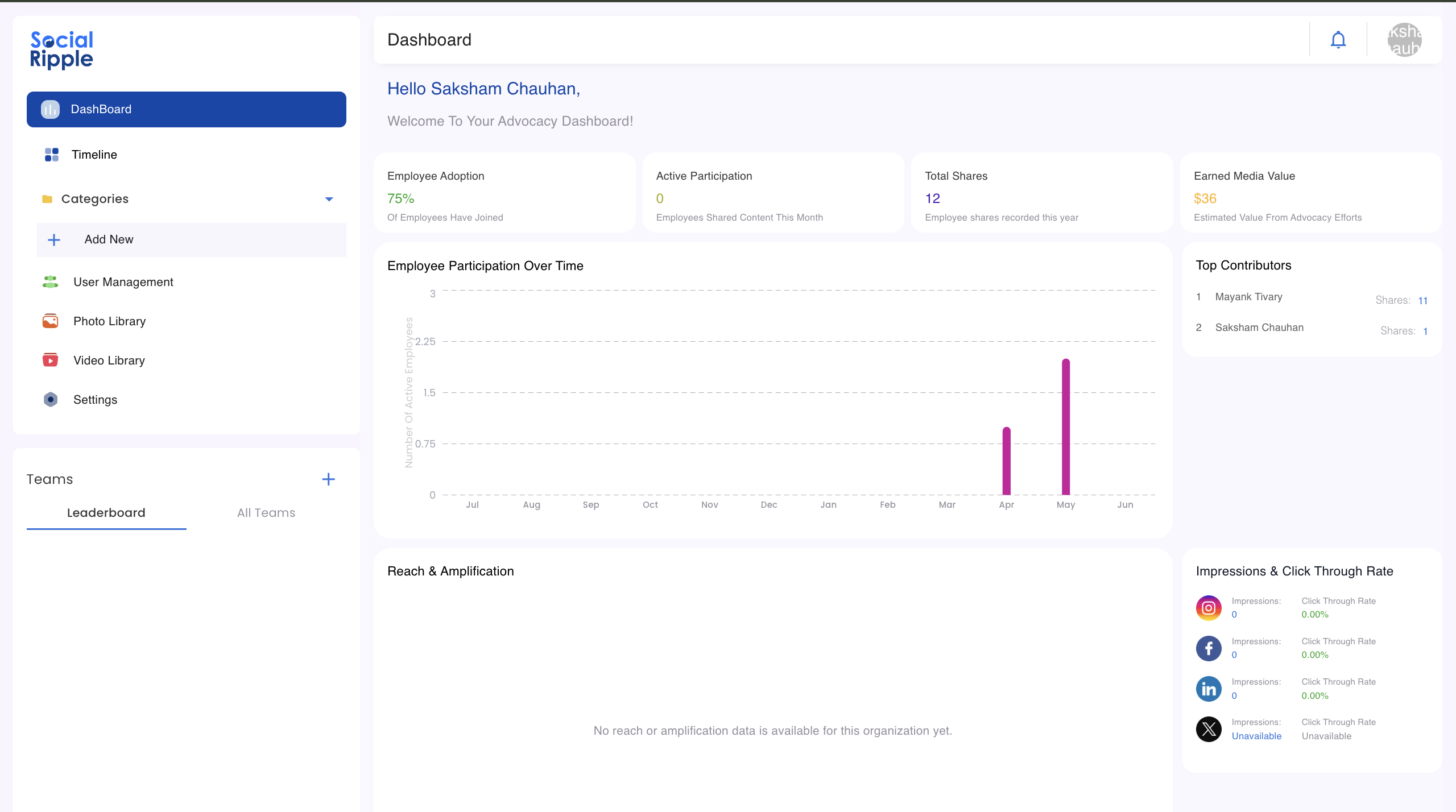
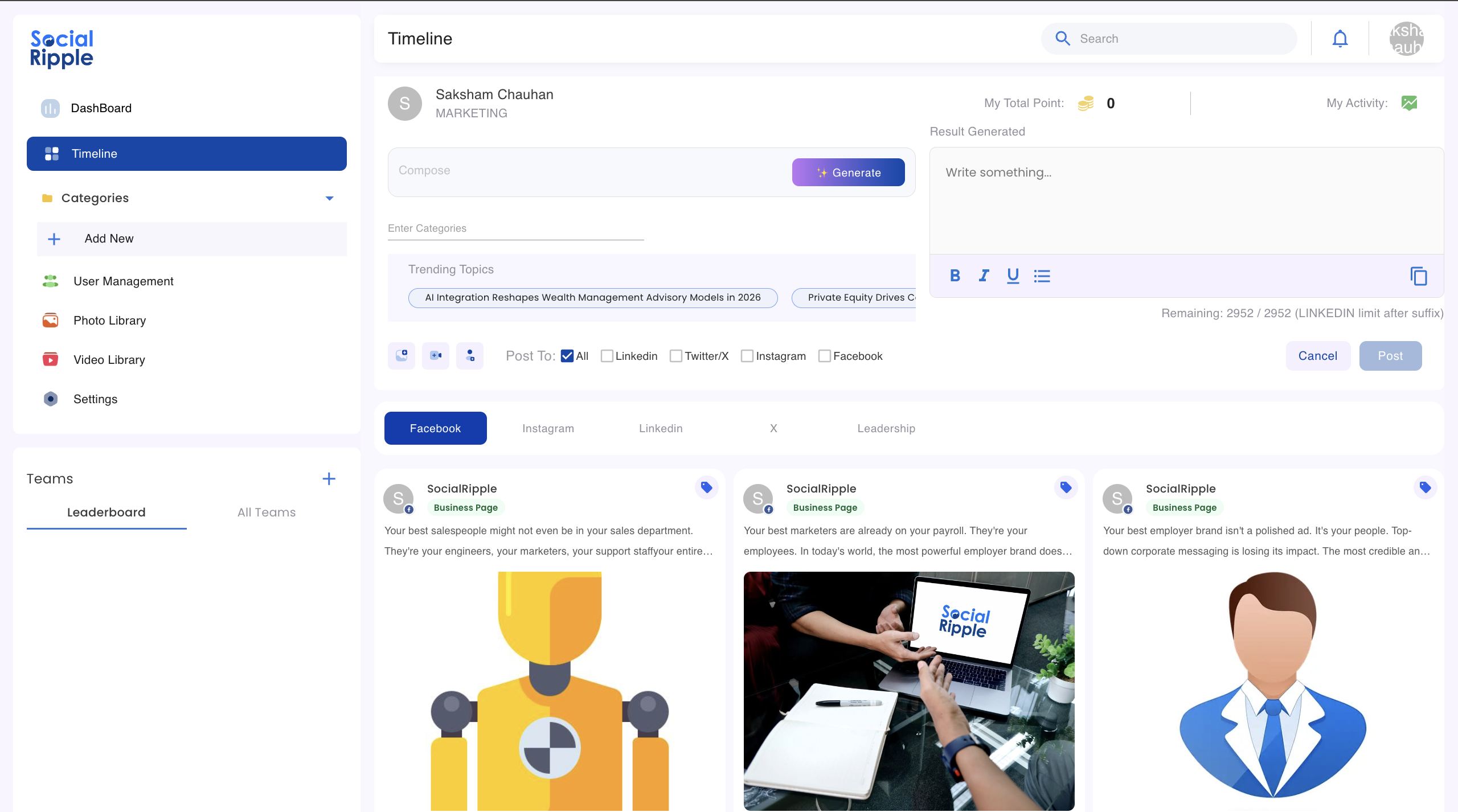
SocialRipple is an early stage employee advocacy platform — software that helps a company's own employees share and amplify its content, turning an internal team into a trusted distribution channel.
I work on it as a side quest outside my main role, alongside its founder Mayank Tivary. It is a deliberately small, two-person effort at the stage where the foundational decisions are still open — which is exactly why being close to the work is valuable.
The problem
Building the wrong thing with conviction
Before a product has real users, the risk is not poor execution. It is building the wrong thing with conviction. An early B2B SaaS idea can look promising on paper and still fail because the demand was assumed rather than tested, the first audience was too broad to serve well, or the team built features before knowing which ones mattered.
SocialRipple needed answers to three questions before committing serious time and code.
Is the market demand real?
Who is the platform actually for first?
What is worth building before anything else?
My work has been about answering those questions with evidence rather than assumption.
Product validation
Testing the opportunity before building.
The first job was to find out whether the opportunity was real and where the platform could genuinely differentiate. The purpose throughout was to replace conviction with evidence, so that what got built next rested on what the market actually wanted, not on what we hoped it wanted.
Competitor analysis
Mapped how existing employee advocacy tools position themselves and where the gaps were — finding the space a new entrant could own rather than where it would be competing on features alone.
User interviews
Talked to target buyers — typically HR and marketing decision-makers — to understand how they actually think about employee advocacy and what they find missing in current options. Not what they said they wanted, but what the friction in their current workflows revealed.
Market study
Sized the opportunity and pressure-tested whether the demand was strong enough to justify building. A market that looks large can still be wrong if the buyers are hard to reach or the problem is not felt sharply enough to drive purchase decisions.
Growth marketing
Making the first users real.
Validation only counts if it comes from real market response, so the second area of work was growth. Instead of guessing whether the positioning resonated, we could watch how real prospects responded to it.
ICP definition
Narrowed the first audience to a segment specific enough to be reached and served well, rather than a broad description that could justify building almost anything. A specific first audience is a forcing function — it makes the product decisions clearer and the marketing more efficient.
Lead generation and campaigns
Set up and ran early lead generation, putting the proposition in front of real prospects so that the signal we learned from came from the market rather than from internal opinion. This made the validation concrete.
Product management
Turning decisions into something buildable.
The third area was translating validated direction into a buildable product. I worked on defining the feature set — deciding what belonged in the first version and what should wait until there was real signal to justify it.
I worked directly with the developers to turn those decisions into something that could actually be built. At two people, there is no layer between deciding what to build and building it, which keeps the loop between learning and shipping short.
“At two people, there is no layer between deciding what to build and building it. That is a constraint and an advantage at the same time.”
Where it stands
Bootstrapped. Ongoing. Target: product market fit by end of 2026.
SocialRipple is ongoing rather than finished. The work so far has turned an open opportunity into a tested, defined direction: a validated sense of demand, a specific first audience, a positioning that has been put in front of real prospects, and a scoped set of features being built against it.
The goal we are working toward this quarter is reaching product market fit — the point where the platform is solving a real problem well enough that the right customers adopt and stay. It is an ambition we are actively building toward, not a claim of arrival.
“The work so far has turned an open opportunity into a tested, defined direction. Three working clients. Active BD. Building toward PMF.”
3
Working clients
Active
BD outreach
2026
PMF target